Monday, 21 January 2019

Mary Queen Of Scots - Review


Mary Queen of Scots got her head chopped off. *Spoiler* Only it isn't really. It is historical fact and it's the exact name of a play by Liz Lochhead so the new film by Josie Rourke is spoiling nothing by beginning the film with Mary Stuart's walk down the Green Mile to her death before jumping back in time 25 years to see the events that would lead her cousin Queen Elizabeth I to sign her death warrant.
Let's quickly address the elephant in the room shall we? No, not the fact that the Scot Mary Stuart is played by an Irishwoman and the English Queen is played by an Aussie in the greatest piece of Scottish cultural misappropriation since Highlander had a Frenchman play a Scot and the world's most famous Scot playing a Spanish-Egyptian! We're talking about the fact that despite introductory text saying that Mary moved to France as an infant, she returns to Scotland at the age of 18 with a perfect Scottish accent (well done Saiorse Ronan who puts Christopher Lambert, Mel Gibson and even Chris Pine admirable efforts to shame).
Historical inaccuracies aside, this account of Mary's rise and fall is well handled by Josie Rourke, who until this point is best known for her stage work directing for the National Theatre and the Donmar Warehouse but on this evidence will seamlessly transfer to further outings on the big screen.
In spite of what the trailers may have implied, with shots of Mary upon a noble steed riding with soldiers and talking about how "swords are not just for show", this is certainly no Braveheart or Outlaw King. The battles hear mainly take place within the walls of castles and parliament chambers as the two Queens become pawns and are maneuvered into opposition by the very knights, bishops, etc who they are meant to govern e.g David Tennant's John Knox and Guy Pearce's William Cecil.
Whilst some will claim that films like this seek to widen any discourse between England and Scotland, similar to the re-release of Braveheart just before the Indy Referendum, in fact what this film sadly highlights is the fact that even 450 years on, some men are still very uncomfortable being ruled and governed by a woman!
One need look not further than the scene where Elizabeth tells William Cecil that she has almost become a man whilst ruling as Queen, unwilling to take a husband as she believes all they will do is scheme and plot to usurp her and take her crown. The exact thing that happens to Mary with her husband Henry Darnley (played by louche, debonair swagger by the Scottish star of the moment Jack Lowden) and her court of supposedly loyal subjects.
As one would expect from a theatre director, Rourke really brings out the best from her actors allowing them to drive the drama forward and the cast is uniformly excellent but the male cast are outshone by the central pairing of Robbie and Ronan (which when written like that makes it look like the film is about a secret meeting between members of Take That and Boyzone during the Nineties).
Their (albeit perhaps fictional) face-to-face meeting is a masterclass that proves that the pen is mightier than the sword and a battle of words can make for just as thrilling a contest as an epic battle of swords and shields.
So while Mary Queen of Scots may have had her head chopped off, Mary Queen of Scots proves that Saiorse Ronan and Margot Robbie stand head and shoulders above the rest of the field proving themselves to be two of the finest actresses of their generation.

4 stars


Friday, 18 January 2019

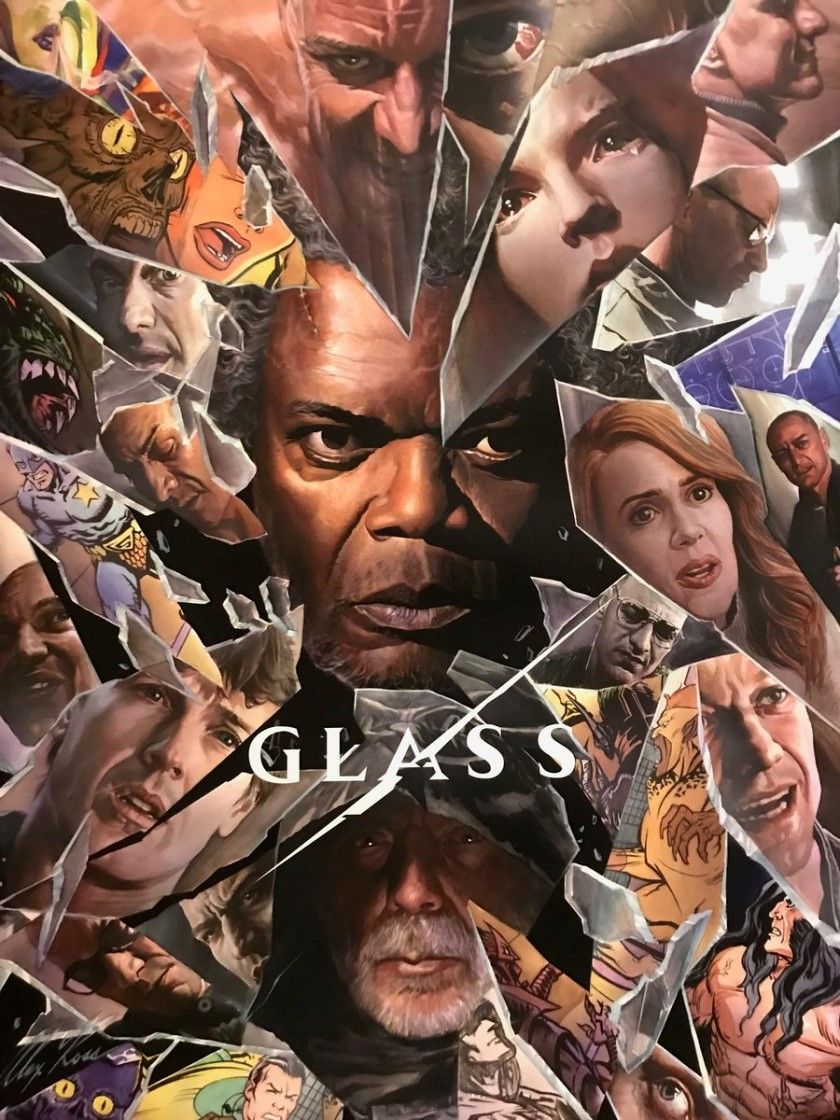
Glass - Review


Even by Unbreakable, writer-director M. Night Shaymalan's films had become synonymous with a twist ending. In fact, The Sixth Sense arguably began the current *SPOILER WARNING* culture we have now, albeit at a time when social media was in its infancy.
However with his 13th feature film Split, he pulled off his greatest trick. Revealing at the film's conclusion that James McAvoy's Kevin Wendell Crumb existed within the Unbreakable universe and it was a secret, stealth sequel to the film setting up more possibilities than Kevin had personalities.
Unbreakable is one of the finest superhero movies (coming at a time before the genre would see its resurgence through X-Men, Spider-Man and the MCU) and the best movie *about* comic books ever made.
The prospect of seeing this expanded universe of Bruce Willis's David Dunn and Samuel L. Jackson's Elijah Price share the screen with Hedwig, Barry, Dennis, Patricia, The Beast et all is a tantalising prospect.
Therefore it would be fair to say that Glass shatters those expectations as easily as Mr. Glass's brittle bones. Shaymalan does not deliver his version of Avengers Infinity War but instead gives us a superhero version of One Flew Over The Cuckoo's Nest as new character Dr. Ellie Staple (the always terrific Sarah Paulson) forces the captured trio to face the possibility that their superhuman powers are simply in their mind. A result of trauma coupled with an over-exposure to comic book culture which has come to oversaturate the world.
It is very pleasing to see Bruce Willis deliver his best performance in years. In fact, one could go as far to say that his last great performance was Unbreakable back in 2001 but it is good to know that he can still turn it on when he gives a damn about the project and not just in it for the paycheck.
Samuel L. Jackson is also on fine form but spends much of the first act in a rather comatose state but soon gets the opportunity to start monologuing before too long.
However the real star of the show, once again, is James McAvoy. Having spent time with the characters in the first movie, his skill and craft has been honed even more that the audience can know instantly tell which of the main characters within Kevin are emerging each time just by his body language. It is an incredible sight to behold and if the world was a just and fair place, this is the type of performance that should be considered when it comes to Awards season. No one else has done anything like what McAvoy has done with a character(s) over these two movies.
Yet the multiple/split personality is perhaps where Glass ultimately loses its superpowers as the film struggles to settle on a tone, changing almost from scene to scene as quickly as Kevin's personalities come into the light. Although titled Glass, it is very much a Split sequel and the sheer energy of McAvoy seems at odds with the quiet and stillness of the other two characters. The film's pacing is languid and more in keeping with the slow burn of Unbreakable but starts with a bang and builds to a third act "showdown" that is full of the traditional twists and turns you would expect from this filmmaker but in a way that is so bold and unexpected that it will undoubtedly Split opinions, pardon the pun.
While it might not quite shatter the glass ceiling of the perfect superhero trilogy, Glass is a fascinating and thrilling analysis of comic book culture and the way we view "heroes".

3 stars


Tuesday, 15 January 2019

Colette - Review


Rather surprisingly, Colette is not based on the fallout of the shocking Oscar snub of Toni Collette for Hereditary but the true story of Colette Willy, the wife of the famed French author and his muse and ghost writer who created and wrote his finest work, the Claudine novels.
Despite the fact that Colette is apparently one of France's biggest selling authors of all-time, this reviewer was shockingly ignorant of her and her story (particularly when a Wikipedia search post film revealed she wrote the novel that was turned into the Oscar winning film Gigi).
Yet that does not matter as the film does an excellent job of taking the audience through Colette's story. From timid, meek ingenue to muse and ghost writer (sometimes to the point of tortured slave labour), through her burgeoning sexual awakening to the point where she truly discovers herself and stands up to her husband demanding full credit for her work.
*Note - these are not spoilers as it is all in the trailer*
Now men taking credit for other people's work is certainly nothing new and what Colette does very well is remind us that sadly not much has really changed in the 119 years since the publication of Claudine a L'Ecole.
Yet Henry Willy, played with relish by Dominic West, is playful, charming, seductive and persuasive in his controlling ways and arguments to keep his name on the books, claiming he is a "brand" and any suggestion that he did not pen the work could be catastrophic and ruin their lifestyle which the books pay for.
He is in many ways the perfect abuser and despite his obvious charms, one hopes that Colette will find a way out from under his grip.
Knightley impresses as Colette, coming into her own just as Colette does when she experiments with her sexuality and gender role. She has always seemed more comfortable and fitting within a period setting and it is no different here, doing a fine job of reminding people of this trendsetter and inspirational role model.
Colette. The best a woman can get. Or should that be the best women can be?

3 stars


Stan & Ollie - Review


If you asked anyone who watched Jon S. Baird's adaptation of Irvine Welsh's Filth that featured a career-best performance from James McAvoy what his next project would be, it is doubtful any of them would have picked a biopic of one of the greatest comedy duos of all-time Laurel and Hardy.
The two are worlds apart with the only real connection being that Bruce Robinson would have certainly gotten them into plenty of fine messes.
However it is clear with every frame of Stan & Ollie that Baird is a genuine fan of the double act and that love and appreciation shines through the screen. Whether that be in a pitch perfect recreation of their iconic dance from Way Out West or their hilarious theatrical stage routines.
However Baird is not afraid to peek behind the curtain and show that behind the make up and fame was a very tumultuous and complicated relationship between the two performers.
Biopics that play out as simple rags-to-riches tales that speed through all the big moments like a jukebox musical playing all the hits can be crowdpleasing but ultimately shallow and dull affairs (*cough* Bohemian Rhapsody*). It is refreshing to find one that focuses on a story or period of history that the public may not be too familiar with in order to show the world who these people really are (or were).
Following the acrimonious break up of the duo due to Laurel's stubbornness over his contract, the two went their separate ways before falling on harder times and reuniting for a theatre tour in the UK with the eye on securing finance for a future film that would put them back on top.
As the two former partners and friends travel round the country performing some of their classic routines to audiences who have moved on with the times, it is clear that they are carrying round more baggage than just their carry on luggage.
The performances of Steve Coogan as Laurel and John C. Reilly as Hardy are spot on, with Reilly disappearing under some impressive make up to become the duo and the two actors spark off each other both on stage and off as they seek to resolve their differences before it's too late.
The chemistry between the two transfers over to the other relationships in their lives, their wives (played with steel and scene-stealing guile by Shirley Henderson and Nina Arianda) but it is clear who the real love of their lives was. It is no coincidence that Laurel (and others) refer to Hardy as "Babe".
The result is an affectionate tribute that packs a surprisingly emotional punch that will have audiences crying tears of sadness and laughter to the point their faces will look like another fine mess they have gotten themselves into.

4 stars


Monday, 14 January 2019

The Front Runner - Review


1988. Ah, the halcyon days of US politics. When the press publishing rumours of a reported affair was enough to have a candidate drop out of the race.
That is not a spoiler. It is the crux of this true life story of Senator Gary Hart. America's golden boy. The titular "front runner" for the Democratic nomination and the man many believed was capable of beating George WH Bush and be the next President... Unfortunately the man just couldn't keep it in his pants!
Jason Reitman's expose of this story is about more than just one man however. This captures a monumental turning point in how the press and the media reported on politics.
Gary Hart's position was that his private life behind closed doors did not affect his ability to perform his job or influence his policies. It was a view that until that point many agreed with, including the likes of The Washington Post (which actually makes for an interesting double bill with The Post), but there were others that believed that politicians needed to be held to a higher ethical and moral standard than others and if you were in the public eye, you were fair game.
Jackman is terrific as Hart. Using his natural charisma and abundance of charm to be the man who could be President when talking about policies (or women) but is equally stiff and awkward around cameras, with his frustration and anger reaching boiling point.
Reitman fills out his cast with regulars such as JK Simmons (once again on fine expletive dropping form), Vera Farmiga and a host of talent that would slot quite easily into a walk and talk segment on The West Wing.
However this is where the film finds itself lacking. It seems churlish to compare and contrast but while it does a perfectly adequate job of retelling the story in the style of a 70s/80s political drama, what it really needs (with the monumental change in the focus of the media at the time) is the satirical bite and razor sharp wit of Aaron Sorkin or In The Loop or The Thick Of It. Satires and comedies that have become worryingly more like documentaries.
On paper, this movie had everything you would for in a prestige Awards season film (great cast, seasoned director, based on a true story, timely political statement), however just as Gary Hart found out to his cost, sometimes that is just not enough and you go from The Front Runner to Also Ran in a heartbeat.

3 stars


Saturday, 5 January 2019

The Favourite - Review


Similar to the main characters jostling for the affections of the Queen, The Favourite is currently living up to its title as one of the favourites for this season's Oscar race but one expects it will not have to lower itself to such underhanded tactics as Sarah and Abigail resort in order to curry favour with the voters.
Director Yorgos Lanthimos (The Lobster, Killing Of A Sacred Deer) brings his trademark sense of humour which is blacker than the Black Death to this acerbic retelling of this historical menage a trois.
The way that Abigail (Emma Stone) and Sarah (Rachel Weisz) scheme and play each other off Queen Anne in a continual battle for her affections, position and power makes it feel akin to the classic All About Eve. If the film had been about another famous Anne, it could have been called All About Cleves.
Queen Anne has a collection of bunnies named after her lost children and the metaphor runs deep as Anne herself at times feels like a frightened rabbit at the mercy of two cunning foxes stalking their prey, albeit too obsessed with fighting each other to truly go in for the kill.
The scenes between Stone and Weisz are electric. Trading witticisms, backhanded compliments and insults as barbed as Negan's baseball bat Lucille from the Walking Dead, and twice as dangerous.
Colman excels as the Queen who is portrayed in public as weak, stupid and cuckolded by Sarah but as the film progresses, questions are raised as to who is really playing who? This leads to an incendiary fallout in the conclusion and an audacious final shot from Lanthimos.
All three women will almost certainly be nominated for awards but it seems a disservice to have them face off against each other (ironically). They are equally great and arguably all leads in a film that aces the Bechdel test to the point the audience forgets that there are actually male characters as well (something the women seem as disinterested in at times). Of these, Nicolas Hoult is the standout as Harley, a man who has schemes of his own afoot.
A period piece as sumptuous to look at and full of romance as a Jane Austen novel but with a cut-throat sense and sensibility more often seen in Game of Thrones.

4 stars


Days of Future Past: Has Science Fiction become Science Fact?


If by some miracle a prophet could describe the future exactly as it was going to take place, his predictions would sound so absurd, so far-fetched that everyone would laugh him to scorn. The only thing we can be sure of about the future, is that it will be absolutely fantastic" 
      - Arthur C. Clarke, World's Fair, New York, 1964

It all started with one simple question: “Why don’t we have hoverboards yet?”
It was January 2015 and film journalists were already preparing their articles ahead of the 5th October 2015. The date that Marty McFly and Doc Brown travel to the future in 1988’s Back To The Future Part II.
Science Fiction films were previously the work of fantasy. Writers and filmmakers creating a vision of the future that they imagined *could* potentially come true but never really thought they would be held accountable for.

"Science fiction was an expression of 20th century man's hopes, dreams and aspirations. A heavy percentage of science fiction is merely rubbish. Big eyed monsters, space battles or something of that nature. However science fiction has one thing in its favour, that even a story that from a literary standpoint is complete trash may prove very prophetic"

While the science fiction films of the past have earned their place in history, the clock has kept ticking and time has begun to catch up with these works of fiction, whether they are novels, television shows or films.

Outside of 2001: A Space Odyssey and Terminator 2 Judgement Day, Back To The Future Part II was the first science fiction film to have a set date that people could finally analyse and compare fact to science fiction.
It presented a vision of the future that featured flying cars, self-tying laces and the release of Jaws 19. To be fair, they got the resurgence of 3D correct. They were also a year out with the Chicago Cubs World Series Win but we’ll let them off because they weirdly kindly of predicted the rise of Trump.

The year is now 2019 and we have reached a time when science fiction is becoming a reality.
The science fiction films of our past are becoming the present. The year 2019 is the setting for films such as Daybreakers, The Road, The IslandAkira and one of the most influential films of all-time, Blade Runner.

What, if anything, did they get right about the future? And what can they teach us about technology, science, health and politics?
Arthur C. Clarke said "One mark of a first rate scientist is an interest in science fiction and conversely, the mark of a second rate scientist is a lack of interest in science fiction."
Where films got their predictions correct, was it because scientists were inspired by the technology seen in the movies? A sort of self-fulfilling prophecy so to speak?

Over the course of 2019, I will examine in detail a series of science fiction films to determine how prophetic they actually were.
The criteria for selection was they had to be set in a specific time period in history or the near future i.e. 2001, 2019, 2032, etc.
Also the films must have been released at least ten years prior to their setting to allow for a reasonable period of time for their predictions to take effect (sorry Geostorm, set in 2019 but released in 2017).

The films that will be analysed are as follows (in chronological order of setting):

  1. 1984
  2. Escape From New York
  3. Death Race 2000
  4. 2001 A Space Odyssey
  5. Timecop
  6. Back To The Future Part II
  7. Barb Wire
  8. V For Vendetta
  9. Rollerball
  10. Akira
  11. Daybreakers
  12. The Island
  13. The Road
  14. The Running Man
  15. Blade Runner
  16. Johnny Mnemonic
  17. The Purge
  18. Soylent Green
  19. Her
  20. Metropolis
  21. Children of Men
  22. Snowpiercer
  23. Moon
  24. Demolition Man
  25. Twelve Monkeys