Monday, 12 March 2018
Wonder Wheel - review
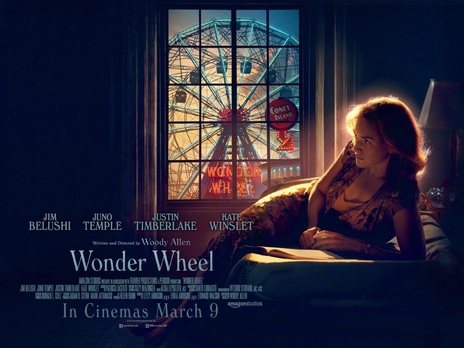
Wonder Wheel was released in cinemas this weekend but you would be forgiven for not realising that as it has had as much fanfare and publicity as an abandoned fairground.
Given the current climate within Hollywood, Woody Allen's latest film has been unceremoniously dumped into cinemas post-Oscars without as much as a trailer or poster to alert audiences to the fact.
No matter your views on Allen as a person or a filmmaker, ultimately the film should be reviewed on its merits and on that alone, it adds context to the decision to slip it out under the radar as it is not a great film at all and certainly in the lower tier of Allen's recent output.
One of the criticisms of Allen's recent work in the Noughties was that his particular brand of comedy and writing did not translate as well to locations such as Barcelona, London, Rome, etc as he went on an extended Euro Trip. His greatest films were always set in his hometown of New York City and Wonder Wheel sees him return to the Big Apple, in particular Coney Island beach.
The tale, set in the 1950s, revolves around the character of Ginny (Kate Winslet), a woman who feels she is wasting her life waitressing at a diner on the Boardwalk, raising a son obsessed with starting fires and is trapped in an unhappy marriage to a recovering alcoholic (Jim Belushi) who works the carousel at Coney Island fairground.
Her mundane life is thrown for a loop bigger than the Thunderbolt rollercoaster when she begins an affair with a young, handsome lifeguard (Timberlake) and also when her husband's 20 year old daughter (Juno Temple) returns home after going on the run from her gangster ex-husband.
If this is starting to sound like a bit like a bad American play, the kind that Joey Tribbiani from Friends would star in, then this is kind of intentional on Allen's part.
The first few scenes are set within an apartment located within the fairground (possibly a direct reference to Annie Hall which also featured a family living beneath the rollercoaster). The dialogue, acting and blocking of these scenes come across as very theatrical. As if the actors were performing a Eugene O'Neill or Tennessee Williams play.
At first it feels very odd but then the reasoning becomes apparent when it is made clear that the story is being narrated by Timberlake's lifeguard Mickey, a young man who dreams of becoming a playwright.
Only he does not have much of a career ahead of him as a wordsmith because the dialogue and plotting are incredibly stilted and on-the-nose.
Timberlake was an effective screen presence in The Social Network, but his casting here seems out of place. He has the matinee looks for a '50s dreamboat but as the Woody Allen cypher in the film, he is not a good match for the dialogue, even if it is nowhere near the calibre of Allen's early days.
In a nice reversal of one of Allen's most reviled plot devices, this movie finally sees an older woman having a romance with a younger man. Even if this romance is threatened by the younger ingenue who enters stage right and sets in motion the events that will lead to the inevitable tragic climax that must feature in an American play.
Allen's films are often the stuff of fantasy. After all, why do so many of them feature a man in his fifties romancing a girl in her twenties?
Wonder Wheel is a romanticised version of New York which features this red, amber lighting that appears on Winslet's face all of the time, no matter what time of day. A light that for some reason can appear to come from two different directions at once and only on the main characters. It is the type of light that only appears in paintings and postcards. Idealised images of a place that wishes to portray a lifestyle that it cannot live up to and this is ultimately Ginny's downfall.
Winslet is the film's saving grace as the third act comes around and her character finally embraces and revels in the drunken Streetcar Named Desire Stella-esque turn.
As for the rest of the movie, it is very similar to the ferris wheel after which Wonder Wheel is named. It might provide a momentary distraction from your daily routine but ultimately it goes nowhere and will leave you right back where you started.
2 stars
Monday, 7 April 2014
Divergent - review
Another year, another adaptation of a "Young Adult" literary sensation aiming to take the crown previously held by Twilight and currently sitting atop the head of Jennifer Lawrence and Hunger Games.
So far the likes of Beautiful Creatures, The Mortal Instruments: City of Bones and The Host have failed to capture the imaginations of the critics, audiences or box office charts.
Is Divergent be able to go in a different direction? Sadly not.
In a future ravaged by a war, society is split into five different factions based on your personality. Abnegation the selfless, Dauntless the brave, Erudite the intelligent, Candor the honest and Amity the peaceful... although apparently some don't fit into a category because they are dressed like homeless people or can flit between categories and are called Divergent.
In a Harry Potter-esque Sorting Hat ceremony, all teenagers chose a faction on their 16th birthday. Tris (Shailene Woodley) discovers she is divergent and chooses to leave her Abnegnation parents behind and become part of the Dauntless group who spend a lot of their time practising parkour and wearing the latest All Saints collection.
There is a potentially interesting story here. The factions were created to prevent further conflict but what caused the original war? The society lives in a post-apocalyptic Chicago which is surrounded by a giant fence but what is its purpose? What is it keeping out? Or is it designed to keep them inside?
Unfortunately none of this really explored as the majority of the 138 minute running time is spent having the new Dauntless recruits go through extensive Hunger Games-style training.
With the book being the first in a trilogy, the film feels like nothing more than an extended first act with a undeveloped, tacked-on climax featuring a plot to eliminate one of the factions by a villainous clipboard-carrying Kate Winslet.
The one positive aspect however is the lead actress Shailene Woodley. She starts off fragile and unsure but slowly grows into a tough character, drawing on various Linda Hamilton/Sigourney Weaver action heroine qualities, and nails the emotional beats perfectly.
Divergent might not be able to differentiate itself from the YA crowd but it does have a stand-out lead. The main fault lies with spending so much time laying the groundwork that it rushes the climax... but let's face it, it's a problem that many young adults encounter early on.
2 stars
Friday, 21 March 2014
Labor Day - review
Labour. An experience that can take much longer than you want and involve some physical and emotional trauma.
Very akin to the experience of watching Labor Day. At least with labour you get a brand new life out of it and it isn't narrated by Tobey Maguire!
Actually it's not that bad but it is difficult to take this film seriously when it nearly ends with the line "It was the first time since that Summer that I tried baking"... Fade to black.
Kate Winslet and Josh Brolin are good as the agoraphobic mother and world's nicest convicted murderer who teaches the son to play baseball, cooks, cleans and helps around the house as he stays with Winslet and her son one Labor Day weekend after he escapes from prison.
Brolin's con and his relationship with Winslet is a case of Stockholm Syndrome as saccharinely sweet and over cooked as the peach pie that features so heavily in the film.
2 stars
Saturday, 22 October 2011
Contagion - review
Warning, this is not a *spoiler*. Within 15 minutes of Contagion, Gwyneth Paltrow is dead. Dead as disco or Colonel Gaddafi. Turns out she was more crudded up than the monkey from Outbreak and is Ground Zero for a disease that will be responsible for killing over 2.6 million people worldwide. Goes to show what happens when you eat healthily, listen to Coldplay and call your children silly names like Apple!
Driven by another terrific electronic score by Cliff Martinez (also responsible for the Drive soundtrack), the first 30 minutes of this film are the worst nightmare for someone with OCD. Soderbergh tracks the path of the virus as it travels across the world as those infected dip their hands into that bowl of communal nuts at the bar or touch elevator buttons or door handles before convulsing and foaming at the mouth like a tweenager at a Justin Bieber concert.
Just as Jude Law's ridiculously annoying, and possibly Australian (I couldn't really decide from his accent), blogger attempts to get rich by claiming a homeopathic remedy is the cure to the disease, I wouldn't be surprised if Soderbergh and the producers have shares in hand sanitizer, because sales are going to go through the roof following screenings of this film!
As the outbreak spreads, the Centre for Disease Control (CDC) and World Health Organisation try to deal with the pandemic, controlling the spread of the disease and finding a possible cure. Cue lots of scenes like this...
The CDC and WHO are the good guys fighting an unseen enemy in this old school disaster movie that features a fantastic cast (Cotillard, Damon, Fishburne, Winslet), and as he proves with Oscar winner Paltrow kicking the bucket so soon, the disease does not care about awards or celebrity status when claiming victims. The gloves are literally and preverbally off, but not for the protaginists... due to health and safety fears, it is best to keep the latex gloves on!
As the authorities begin to get a handle on how to deal with the MEN-1 virus, the focus shifts slightly to hint that our fellow man can be just as dangerous as society threatens to break down due to the pressures of trying to survive. At one point Fishburne's head of CDC tells Law's blogger that his panic causing lies and misinformation are just as damaging as the virus. Law is also told that "blogging is writing. It's graffiti with punctuation" but I'm sure Elliot Gould was talking about this site when he said it.
By having a large ensemble cast with multiple plot threads, it is inevitable that like the virus, some strains of the film are stronger than others. Winslet and Damon make the most out of their parts, Law is on screen too much for my liking and unfortunately the wonderful Marion Cotillard gets lost in the mix and misses out on a suitable payoff to her storyline.
Overall the film, like the virus, loses momentum once a vaccine has been found. Perhaps there is a reason why most films of this nature end quickly after the virus is defeated, here we get some sense of the fallout and after effects, but it does answer the question of what happened to Jennifer Ehle after Pride & Prejudice all those years ago. Turns out she was working at the CDC.
Soderbergh almost manages to end it on a nice moment with Damon, his daughter and a digital camera which provides a clue as to the cause of the outbreak, which is then ruined by showing exactly what happened, as if to bludgeon home the point to stupid viewers who can't work things out for themselves.
Hopefully this won't be indicitive of Soderbergh's career if the rumours of his retirement prove to be correct.
If he does retire, I'm sure he'll be happy sleeping on a bed made of money gained from the profits of rocketing sales of hand sanitizer.
3 stars
