Showing posts with label Woody Allen. Show all posts

Monday, 12 March 2018

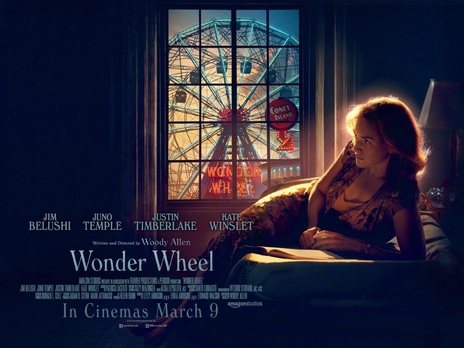
Wonder Wheel - review


Wonder Wheel was released in cinemas this weekend but you would be forgiven for not realising that as it has had as much fanfare and publicity as an abandoned fairground.
Given the current climate within Hollywood, Woody Allen's latest film has been unceremoniously dumped into cinemas post-Oscars without as much as a trailer or poster to alert audiences to the fact.
No matter your views on Allen as a person or a filmmaker, ultimately the film should be reviewed on its merits and on that alone, it adds context to the decision to slip it out under the radar as it is not a great film at all and certainly in the lower tier of Allen's recent output.
One of the criticisms of Allen's recent work in the Noughties was that his particular brand of comedy and writing did not translate as well to locations such as Barcelona, London, Rome, etc as he went on an extended Euro Trip. His greatest films were always set in his hometown of New York City and Wonder Wheel sees him return to the Big Apple, in particular Coney Island beach.
The tale, set in the 1950s, revolves around the character of Ginny (Kate Winslet), a woman who feels she is wasting her life waitressing at a diner on the Boardwalk, raising a son obsessed with starting fires and is trapped in an unhappy marriage to a recovering alcoholic (Jim Belushi) who works the carousel at Coney Island fairground.
Her mundane life is thrown for a loop bigger than the Thunderbolt rollercoaster when she begins an affair with a young, handsome lifeguard (Timberlake) and also when her husband's 20 year old daughter (Juno Temple) returns home after going on the run from her gangster ex-husband.
If this is starting to sound like a bit like a bad American play, the kind that Joey Tribbiani from Friends would star in, then this is kind of intentional on Allen's part.
The first few scenes are set within an apartment located within the fairground (possibly a direct reference to Annie Hall which also featured a family living beneath the rollercoaster). The dialogue, acting and blocking of these scenes come across as very theatrical. As if the actors were performing a Eugene O'Neill or Tennessee Williams play.
At first it feels very odd but then the reasoning becomes apparent when it is made clear that the story is being narrated by Timberlake's lifeguard Mickey, a young man who dreams of becoming a playwright.
Only he does not have much of a career ahead of him as a wordsmith because the dialogue and plotting are incredibly stilted and on-the-nose.
Timberlake was an effective screen presence in The Social Network, but his casting here seems out of place. He has the matinee looks for a '50s dreamboat but as the Woody Allen cypher in the film, he is not a good match for the dialogue, even if it is nowhere near the calibre of Allen's early days.
In a nice reversal of one of Allen's most reviled plot devices, this movie finally sees an older woman having a romance with a younger man. Even if this romance is threatened by the younger ingenue who enters stage right and sets in motion the events that will lead to the inevitable tragic climax that must feature in an American play.
Allen's films are often the stuff of fantasy. After all, why do so many of them feature a man in his fifties romancing a girl in her twenties?
Wonder Wheel is a romanticised version of New York which features this red, amber lighting that appears on Winslet's face all of the time, no matter what time of day. A light that for some reason can appear to come from two different directions at once and only on the main characters. It is the type of light that only appears in paintings and postcards. Idealised images of a place that wishes to portray a lifestyle that it cannot live up to and this is ultimately Ginny's downfall.
Winslet is the film's saving grace as the third act comes around and her character finally embraces and revels in the drunken Streetcar Named Desire Stella-esque turn.
As for the rest of the movie, it is very similar to the ferris wheel after which Wonder Wheel is named. It might provide a momentary distraction from your daily routine but ultimately it goes nowhere and will leave you right back where you started.

2 stars

Monday, 22 September 2014

Magic In The Moonlight - review

A magic trick instantly loses its appeal when you can work out how it's done but it should entrance you and dazzle you so much that you aren't paying attention enough to notice.

Unfortunately the central casting of Colin Firth, as an incredibly obnoxious and unlikeable magician, and Emma Stone, a vapid medium who has less character than the sprits she claims to speak with, fails to create that magic resulting in very little chemistry (not helped that he is old enough to be her father).

Any potential love for this new slice of Woody Allen fades quicker than a non-existent spirit returning to the other side.

2 stars

Tuesday, 27 May 2014

Fading Gigolo - review

Watching Fading Gigolo in many ways was similar to the experience of being with a gigolo or escort.

Having decided to experience it, possibly read some online reviews to help you make up your mind, agree on a time and place, there is the exchange of money, you sit back in the dark nervously unsure of what to expect and when it's over you are left with that mixture of dissatisfaction and shame at what you've both done.

Three Six Mafia once said "It's hard out here for a Pimp" and Woody Allen finds that is is exactly that when he is brought in front of a court of Rabbis for potentially corrupting the widow of a Hassidic Jew in a weird scene that I was unsure if it was meant to be a Coen-esque comic oddity or deadly serious.

It is as if writer-director John Turturro's gigolo has been asked to act like a cross between a Woody Allen film and a Coen Brothers movie and he sadly suffers from performance issues and the result is a bit of a flop.

One of the main issues with the film is the lack of explanation and motivation in the two main characters.

Woody Allen (playing Woody Allen and the highlight of the film) is having to sell his antique bookstore and persuades his florist-plumber friend Fioravante (John Turturro) to become a male escort in order to make extra cash which they will split.

Allen lives with an African-American women and her large family of children but the nature of their relationship is never discussed. Likewise Fioravante is apparently strapped for cash but seems to live in a nice apartment, is constantly referred to as a plumber but never does any (unless it is a euphemism and the only pipes he cleans are lonely women's) and just seems to accept becoming a "ho" without any real fight or reason.

The only real honest characters are his clients, in particular Sharon Stone's unhappily married dermatologist and Vanessa Paradis's widow.

There is an obstacle to Fioravante's relationship with Avrigal that involves Liev Schreiber's Orthodox Security Cop which delivers the film's most implausible plot development.

And that is saying something when it is in a movie where we are supposed to believe that Sharon Stone and Sofia Vergara would have to pay someone to join in a threesome with them!

Sadly this is one gigolo that certainly isn't worth paying for.

2 stars

Saturday, 8 October 2011

Midnight In Paris - review

2011 has been a great year for cinema so far in terms of producing quality films and a full range of emotional responses in this film geek.  I've LOL'd (Bridesmaids), I've been brought to tears for the first time (Warrior), been shellshocked (Kill List, The Skin I Live In) and now Midnight In Paris has the honour of being the first film this year to leave me with a warm, fuzzy feeling inside.


Woody Allen is one of the most prolific filmmakers of all time.  He produces a film every film - take that Terrence Malick - but with such a high turnover rate, there is bound to be some quality issues from time to time.  Critics are always hoping to be able to tag each new Woody Allen film as "a return to form", like they are desperate for him to deliver another Manhattan. But Woody has left Manhattan behind and is in the middle of his Eurotrip that has included London (not successful), Barcelona (mildly successful), and now Paris (c'est tres bon!).
One of the criticisms thrown at Woody during his stay in London was that he shot a tourist's version of London, where everything seemed to be set at the Gherkin or other easily identifiable landmarks.  In Paris, he seems to be giving a nod and a wink to his critics by starting off the movie with a snapshot of a tourist's view of Paris (Louvre, Eiffel Tower, Notre Dame, etc.  It's very accurate, I've been there and they were my immediate impressions of it), but once this is finished he quickly gets down to business and focuses on telling us an utterly charming and funny story.
Gil Pender (Owen Wilson), a Hollywood screenwriter who dreams of writing a "proper novel" who joins his fiancee Inez (Rachel McAdams) in tagging along with her condescending parents on a business trip to Paris.  Enamoured by the vibe and the culture, Gil decides to walk the streets of Paris at night alone instead of hanging around with Inez's insufferable know-it-all lecturer Paul (a wonderful Michael Sheen), and hitching a lift in a vintage car Gil ends up partying the night away with F. Scott Fitzgerald, Cole Porter and Ernest Hemingway... wait, that can't be right, can it?
Yes it can actually, because Midnight In Paris is Allen's love letter to the "Golden Age" of Paris and uses a fantastical time travel mechanism to transport Gil back to the roaring twenties where the creative and cultural elite descended upon Gay Paree.
Owen Wilson, once again doing an excellent job at portraying Owen Wilson, proves to be a natural fit for the Allen role and helps to sell the central concept with his charm and enthusiasm, so much that we don't care whether it is real or just in Gil's head.
This "Moveable Feast", as Hemingway called it, is filled with some delightful cameos; Adrien Brody is delightfully nutty as "Da-Lee", a relatively unknown (to me at least) Corey Stall is terrific as Hemingway and Marion Cotillard, the most beautiful creature to have ever graced the silver screen, is utterly beguiling as Picasso's lover and Gil's potential muse Adriana.  I myself would question returning to the present if it meant getting to stay with Marion.
However there is an underlying message to Allen's screenplay that works on a number of levels.
Gil's novel concerns a man who works in a Nostalgia shop, which Paul critiques as "Nostalgia is denial - denial of the painful present... the name for this denial is golden age thinking - the erroneous notion that a different time period is better than the one ones living in - its a flaw in the romantic imagination of those people who find it difficult to cope with the present."
Gil realises during one of his midnight jaunts Adriana reveals she wishes she could have lived in the era of Belle Epoque and the people there yearn for the Renaissance, and the reality that by living in the past, it will never be enough and Gil is missing out on the present and what possibilities lie in store for him there.
This notion is also true for fans and critics of Woody Allen.  They spend so much time going on and on about how great his films were during the late seventies and early eighties, that they could be blinding themselves to the fact that Allen can still produce some terrific films today, and Midnight In Paris is one that can rank up there with the best of his back catalogue.
Just like the opening sequence of Manhattan always makes me want to go to the Big Apple, by the end of Midnight I was ready to book a another trip to Paris and immediately digging out my copy of A Moveable Feast... now who's getting all nostalgic?

5 stars